Takeaways from the HSJ Medicines Forum 2026 for Industry

The HSJ Medicines Forum 2026 took place this October and brought together brilliant minds from across various avenues of UK healthcare to discuss the future of medicines.
There was a particular focus on the developments highlighted within the 10-year health plan, technological impacts, the rise of genomics and biosimilars as well as the shifts towards neighbourhood health.

With several panels and mind-meeting throughout the day, the event brought together representation from across the NHS, including GPs, commissioners, ICB leads and pharmacists, as well as representation from suppliers from Industry and pharma.
Top 10 strategic implications for NHS suppliers and industry (2027-2029)
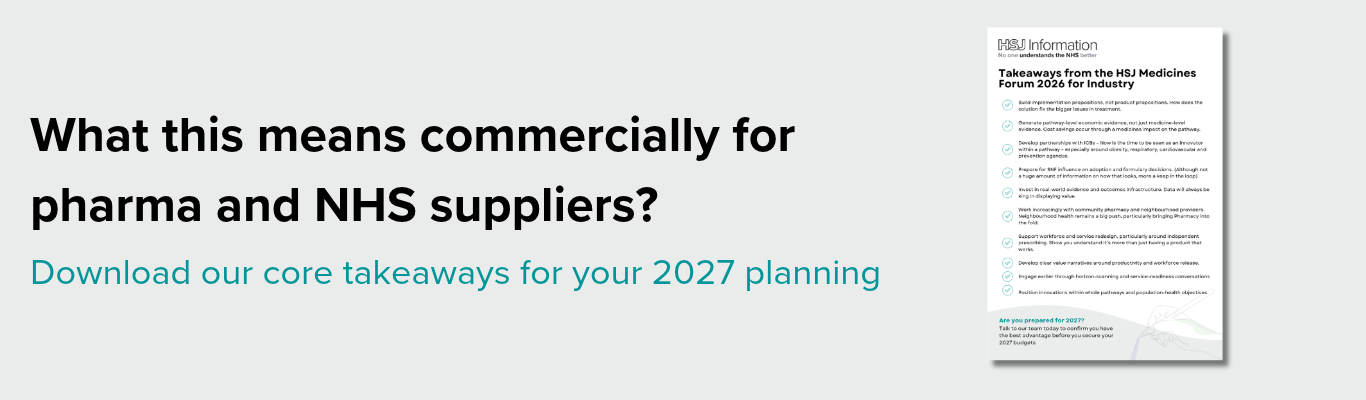
Many useful insights were shared and discussed, with some core themes coming to the forefront of consideration for the pharma industry and NHS suppliers.
1. The Single National Formulary (SNF) will become a major route to scale
The SNF emerged repeatedly as a key NHS reform. It is intended to reduce variation, provide a consistent evidence base and embed guidance into prescribing workflows, with large-scale rollout accelerating towards 2027. Companies need to understand how the SNF will impact engaging ICBs on a local and national level to effectively navigate launching products.
2. Implementation capability matters more than product price
Across multiple sessions, NHS leaders argued that the main barrier to uptake is no longer medicine acquisition cost but service readiness, pathway redesign, workforce capacity, diagnostics, monitoring and patient identification. Partners who can help collaborate and navigate implementation challenges will have a significant advantage in engaging the NHS as a go-to choice.
3. Evidence must demonstrate whole-system value
The NHS increasingly wants evidence that medicines reduce admissions, avoid exacerbations, improve productivity, reduce waiting lists, support return to work, release workforce capacity and improve outcomes, rather than simply showing clinical efficacy or acquisition cost savings. The language of "cost avoidance" is being replaced by "system value".
4. Pathway-based commissioning is replacing medicine-by-medicine thinking
Several speakers stressed that innovation arrives in waves, not as individual medicines. Obesity medicines, cancer pathways, respiratory care and biologics are increasingly viewed through whole pathways. Companies that present pathway redesign solutions rather than individual brands will be better aligned with NHS priorities.
5. Prevention and population health are becoming the dominant value framework
The NHS is increasingly evaluating medicines through their contribution to prevention, population health management and reducing inequalities. Cardiovascular disease, respiratory disease, obesity and long-term conditions are likely to remain priority therapeutic areas because they support wider NHS and government objectives and play an important part reducing the future disease burden.
6. Partnership with industry is becoming more accepted, but must be transparent
A notable change in tone was the explicit recognition that NHS innovation cannot be delivered without industry collaboration. However, NHS leaders repeatedly emphasised transparency, shared objectives, clear governance and planned exits from funded programmes. "Partnership" is no longer viewed negatively, but expectations are higher.
7. Real-world data, outcomes tracking and indication-based prescribing will become increasingly important
The NHS is seeking better linkage between prescribing, outcomes and commissioning decisions. Capturing treatment indication, generating real-world evidence and measuring post-launch outcomes were highlighted as major future capabilities. Companies that can support outcomes measurement and evidence generation will be well positioned.
8. Community pharmacy and neighbourhood health models are emerging as major delivery channels
The shift from hospital to community care is accelerating. Speakers repeatedly highlighted independent prescribing, neighbourhood teams, community pharmacy estate, and integrated delivery models. Suppliers should design services around patients and the community settings rather than assume secondary care remains the principal route for innovation adoption.
9. Horizon scanning and lifecycle management are becoming strategic priorities
The NHS wants to move from reactive adoption to multi-year planning. The refreshed UK PharmaScan, NICE lifecycle management, biosimilar planning, patent-expiry planning and multi-year commissioning strategies all point towards earlier engagement in the product lifecycle. Companies need to engage earlier and provide implementation and service delivery information much further upstream than before.
10. Biosimilars were discussed as a template for future adoption and access programmes
The strongest practical example discussed was biosimilar implementation. The lessons were clear: early planning, multidisciplinary clinical leadership, gain-share arrangements, patient engagement, pathway redesign and reinvestment of savings. NHS leaders appear keen to apply this model to broader innovation adoption. Suppliers should expect future launches to be assessed against the standards achieved in biosimilar programmes.
Are you best positioned to be a go-to partner for the NHS in 2027 and beyond?
The end of the year is fast approaching and the time to lock down budgets is on the horizon. Are your teams best placed to navigate the new NHS and be a go-to partner in the coming years?
HSJ Information healthcare solutions can empower your teams to engage the NHS and collaborate for better outcomes for patients, the healthcare system and your commercial goals. We have a unique position within UK healthcare so make sure to speak to our consultants before securing your budgets to make sure you have the expertise of the team that the NHS relies on for information, after all: No one understands the NHS better.